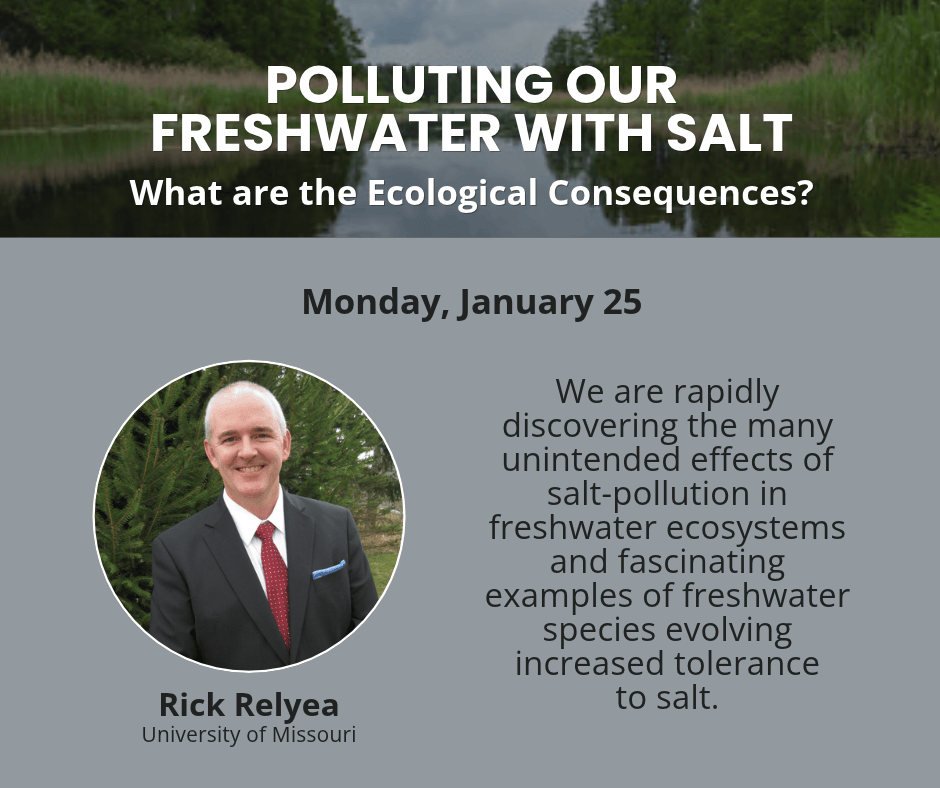
Monday, January 25
1:30pm ET/12:30pm CT
Description: Around the world, freshwater habitats are experiencing salinization as a result of human activities, including mining, agriculture, saltwater intrusion, and the applications of road salts to melt ice and snow. We are rapidly discovering the many unintended effects of salt-pollution in freshwater ecosystems and these effects span multiple levels of ecology, including individuals, populations, communities, and ecosystems. In addition, we are discovering fascinating examples of aquatic taxa evolving increased tolerance to salt, suggesting that some species may be able to persist as we work to mitigate salt pollution. Fortunately, as the public has learned more about the environmental and economic impacts of salt pollution, new strategies have been developed to apply road salts in smarter ways that allow up to 50% reductions in salt applications without compromising road safety. Thus, we can protect the environment while also experiencing considerable savings for transportation agencies and taxpayers.
Presenter
Rick Relyea is the William J. Rucker Professor in Fisheries and Wildlife at Mizzou. He received a B.S. in Wildlife Biology from the SUNY College of Environmental Science and Forestry, an M.S. in wildlife management from Texas Tech University, and a PhD in Ecology and Evolution from the University of Michigan. Rick has authored more than 200 scientific articles and presented research seminars throughout the world. He has also authored 15 textbooks over the past 15 years. He was a professor at the University of Pittsburgh from 1999-2014 where he served as the director of Pitt’s Biological Field Station. In 2014, he moved to Rensselaer Polytechnic Institute in NY to direct their Fresh Water Institute. In 2025, Rick moved to Mizzou to be the Inaugural Director of the Johnny Morris Institute of Fisheries, Wetlands, and Aquatic Systems.


