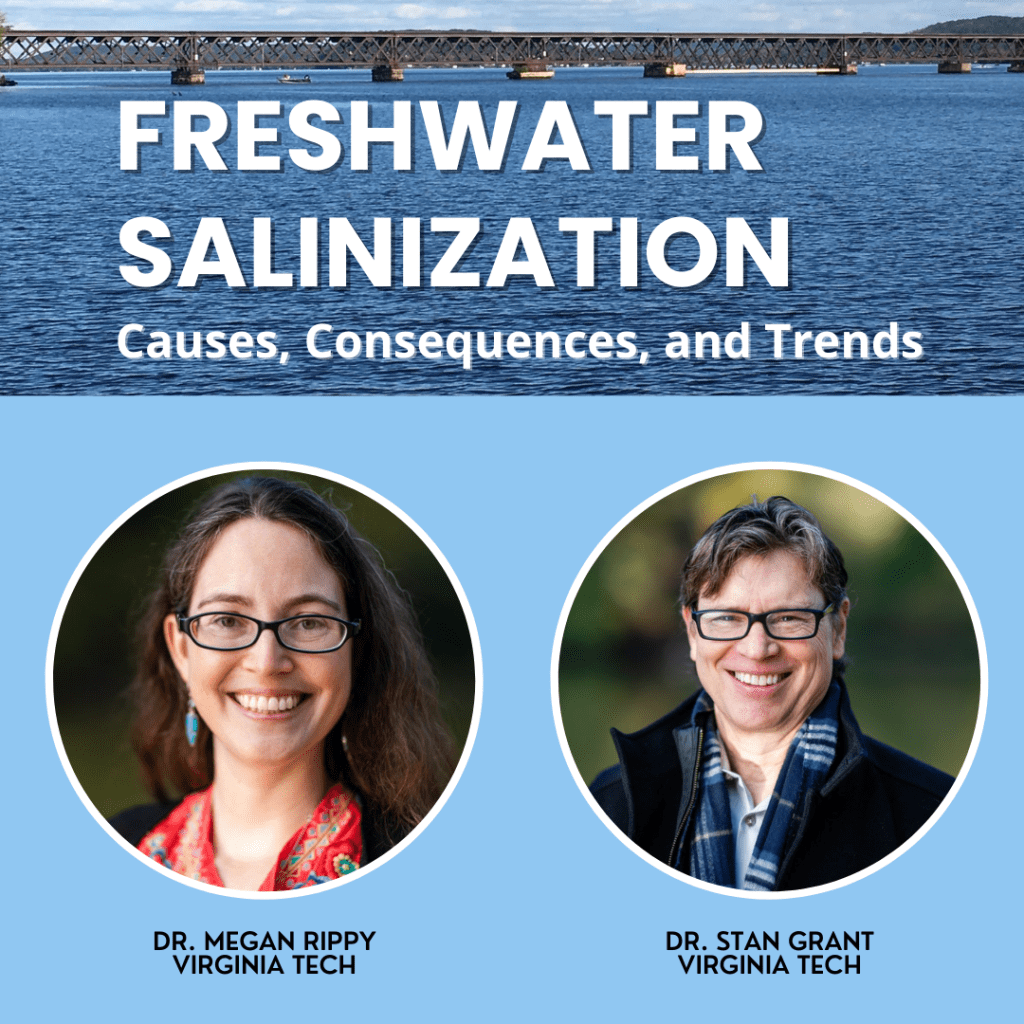
Monday, January 26 – 1:30pm ET/12:30pm CT
Get the big-picture view of freshwater salinization and why it’s emerging as a critical water-quality challenge across the country. We’ll break down the major drivers, the ecological and infrastructure impacts, and the trends scientists are tracking in rivers, lakes, and groundwater. Then we’ll zoom in on a real-world case study from the Occoquan Reservoir, where researchers and managers are grappling with the complex mix of land use, weather patterns, and human behavior that fuels rising chloride levels. This case will illustrate both the challenges and the practical management strategies communities can use to protect their drinking water supplies.
Presenters
Dr. Stanley Grant is a Professor of Civil and Environmental Engineering at Virginia Tech, and Director of the Occoquan Watershed Monitoring Lab (OWML) in Northern Virginia. He studies pollutant fate and transport through aquatic systems. In 2020, Stan and his team were awarded a $3.6M NSF-funded Growing Convergence Research grant to study novel approaches for managing inland freshwater salinization.
Dr. Megan Rippy is an Assistant Professor of Civil and Environmental Engineering at Virginia Tech, stationed at the Occoquan Watershed Monitoring Lab in northern Virginia. Her professional interests include 1) the effects of urban stormwater on aquatic ecosystems and public health, 2) characterization and modeling of green infrastructure co-benefits and their social, ecological, and hydrological drivers and 3) urban water security (particularly during times of drought). She is currently working on extending ecosystem service valuation frameworks to include constructed urban greenspaces like green stormwater infrastructure, and is part of a multi-university team working together to characterize how green infrastructure is perceived by the public, and what drives those perceptions. Ecosystem Services Lab website.
Want to know more?
Researcher studies the power of native plants to combat road salt pollution (January, 2025)
Salt levels in drinking water could be near tipping point (November, 2022)

 Winter Salt Week - January 26-30, 2026